
What Actually Happens When a Web Game Goes Viral (And Why Most Portals Aren't Ready For It)

Play the game
Tower Defenders
Going viral is supposed to be the good outcome. For an ad-monetized HTML5 portal, the first 48 hours of a genuine viral spike often look much closer to an operational emergency than a celebration, and the reason has nothing to do with the game itself and everything to do with three mechanics that don't get discussed nearly enough outside of actual ops teams.
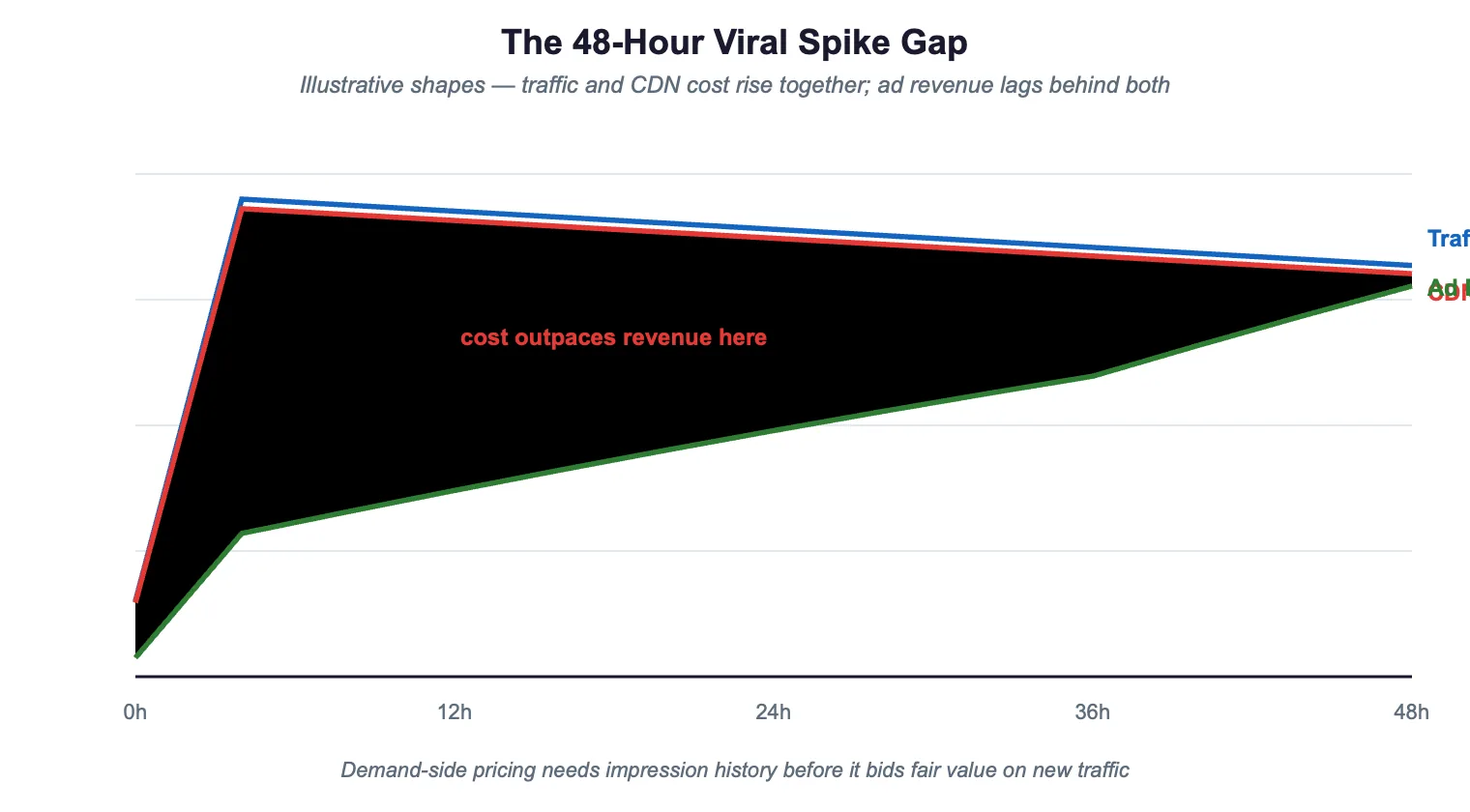
The first is the simplest and the most immediately painful: CDN cost scales with traffic in a way ad revenue doesn't, especially in the short term. A viral spike means a sudden multiple-times increase in requests for game assets — JS bundles, WASM binaries, texture and audio files, all of it pulled from CDN edge nodes at a rate the portal's normal traffic pattern never approached. CDN billing is typically metered on bandwidth and request volume, which means the cost line moves almost immediately and almost linearly with the traffic spike. Ad revenue does not move the same way, for reasons that have nothing to do with how good the game is and everything to do with how programmatic advertising actually prices new inventory.
That's the second mechanic, and it's the one that catches operators off guard even when they've planned for the infrastructure cost. Programmatic demand doesn't instantly recognize a sudden, large volume of new impressions from a specific domain or placement as valuable inventory worth bidding aggressively on. Demand-side platforms build pricing models based partly on historical performance data for a given inventory source — conversion patterns, audience quality signals, past fill rates. A traffic spike that didn't exist yesterday has none of that history yet. The practical result is a real, measurable lag between when impression volume spikes and when demand actually catches up to bid competitively on that volume, which means the first 24 to 48 hours of a viral event frequently monetize at a noticeably lower effective CPM than the portal's normal baseline traffic, even while the absolute impression count is far higher than usual. The revenue does eventually catch up, once enough impression history accumulates for demand platforms to price the inventory properly. It just doesn't catch up on the same timeline the cost spike hits on.
The third mechanic is the one that actually compounds the first two rather than just running alongside them: server response time degradation under sudden load directly damages the session quality the portal needs to capture whatever ad revenue is available. A portal humming along at a 200-millisecond baseline response time under normal traffic can see that number climb to well over a second, sometimes well past a second and a half, once concurrent load multiplies past what the infrastructure was provisioned for. That's not a cosmetic slowdown. Load time correlates directly and steeply with bounce rate — users abandon slow-loading pages at a rate that climbs sharply once load times cross certain thresholds, and a web game that takes 1.5 seconds to respond during exactly the moment it's getting the most new, unfamiliar visitors is bleeding exactly the users least likely to be patient enough to wait it out. The viral spike that should be generating the highest session volume of the portal's history is simultaneously generating its worst bounce rate, at the worst possible moment for that metric to degrade.

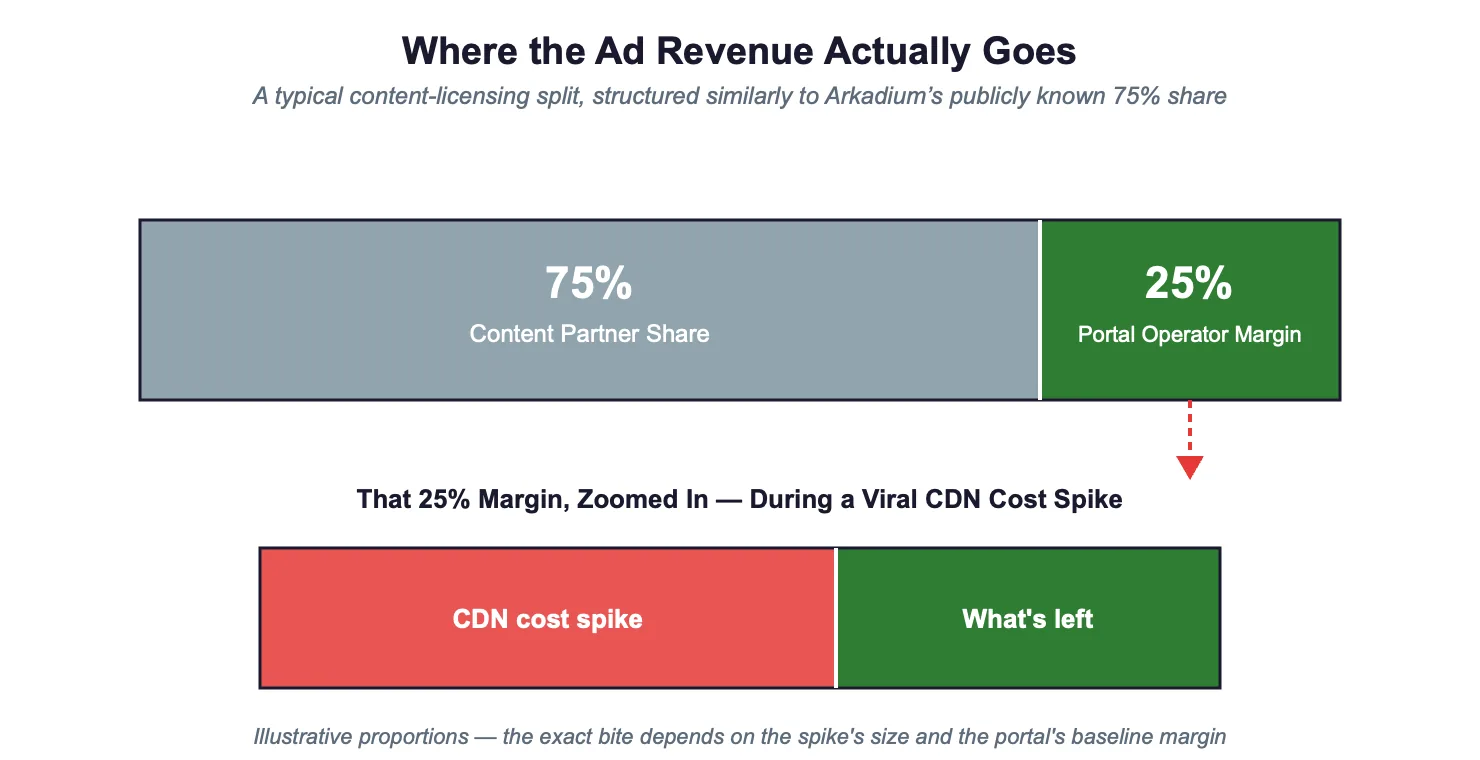
Put all three together and the timing mismatch becomes obvious: infrastructure cost spikes immediately, ad revenue lags for one to two days before catching up to fair value, and the degraded load times during exactly that window actively suppress the session quality that would otherwise help close the gap faster. For a portal running on the thinner end of the revenue-share spectrum — the kind of arrangement where a meaningful share of gross ad revenue is already committed to a content-licensing partner under deals structured similarly to Arkadium's well-documented 75% publisher share, leaving the portal operator with comparatively little margin — that 24-to-48-hour gap isn't a minor cash flow wrinkle. It's the exact window where the portal needs working capital to cover a CDN bill that's already arrived, against revenue that technically exists but hasn't been collected or even fully priced yet.
None of this means viral traffic is bad for a portal's business. It almost always nets out as a clear positive once the dust settles and demand-side pricing normalizes against the new traffic baseline. But the operators who handle viral spikes well aren't the ones who get lucky with their infrastructure. They're the ones who've already modeled this exact 48-hour gap before it happens, and built enough buffer — in CDN contracts, in cash reserves, in realistic expectations about day-one and day-two RPM — to survive the lag without panicking through it.
🎮 Ready to play? Try these games on VPlay:
- Tower Defenders — Strategic tower defense built for massive concurrent browser play
- Candy Jewels — Match-3 puzzle that scales seamlessly from casual players to viral traffic spikes
- Element Blocks — Block puzzle with satisfying visual feedback, optimized for global browser delivery
- Pool Master — Classic 8-ball pool reimagined for instant browser access worldwide
Play these games



More from the blog

The Developer's Guide to Getting Your Game Featured on a Portal
Every week, our team at VPlay reviews dozens of game submissions from developers around the world. Some are polished, some are rough, some are genuinely surprising. And every single developer who subm

Saudi Arabia's Gaming Investments Are Bigger Than Most People Realize
The easy version of this story writes itself: a petrostate with deep pockets decides gaming looks profitable, buys some equity stakes, collects a press cycle's worth of headlines, moves on. That frami

The Hidden Cost of App Store Discovery
For most of the last fifteen years, the 30% cut Apple and Google take on app store transactions has been treated as a fixed cost of doing business, the way a retail tenant treats rent — annoying, occa