
Saudi Arabia's Gaming Investments Are Bigger Than Most People Realize

Play the game
Archer: Trial by Fate
The easy version of this story writes itself: a petrostate with deep pockets decides gaming looks profitable, buys some equity stakes, collects a press cycle's worth of headlines, moves on. That framing has been applied to Saudi Arabia's gaming investments often enough that it's worth stating plainly why it's wrong, or at least badly incomplete. The actual structure of what's been built over the past several years looks much less like passive capital chasing a trendy sector and much more like a deliberate attempt to control specific layers of the gaming value chain, with a regional distribution thesis attached that has direct implications for anyone thinking seriously about MENA as a market.
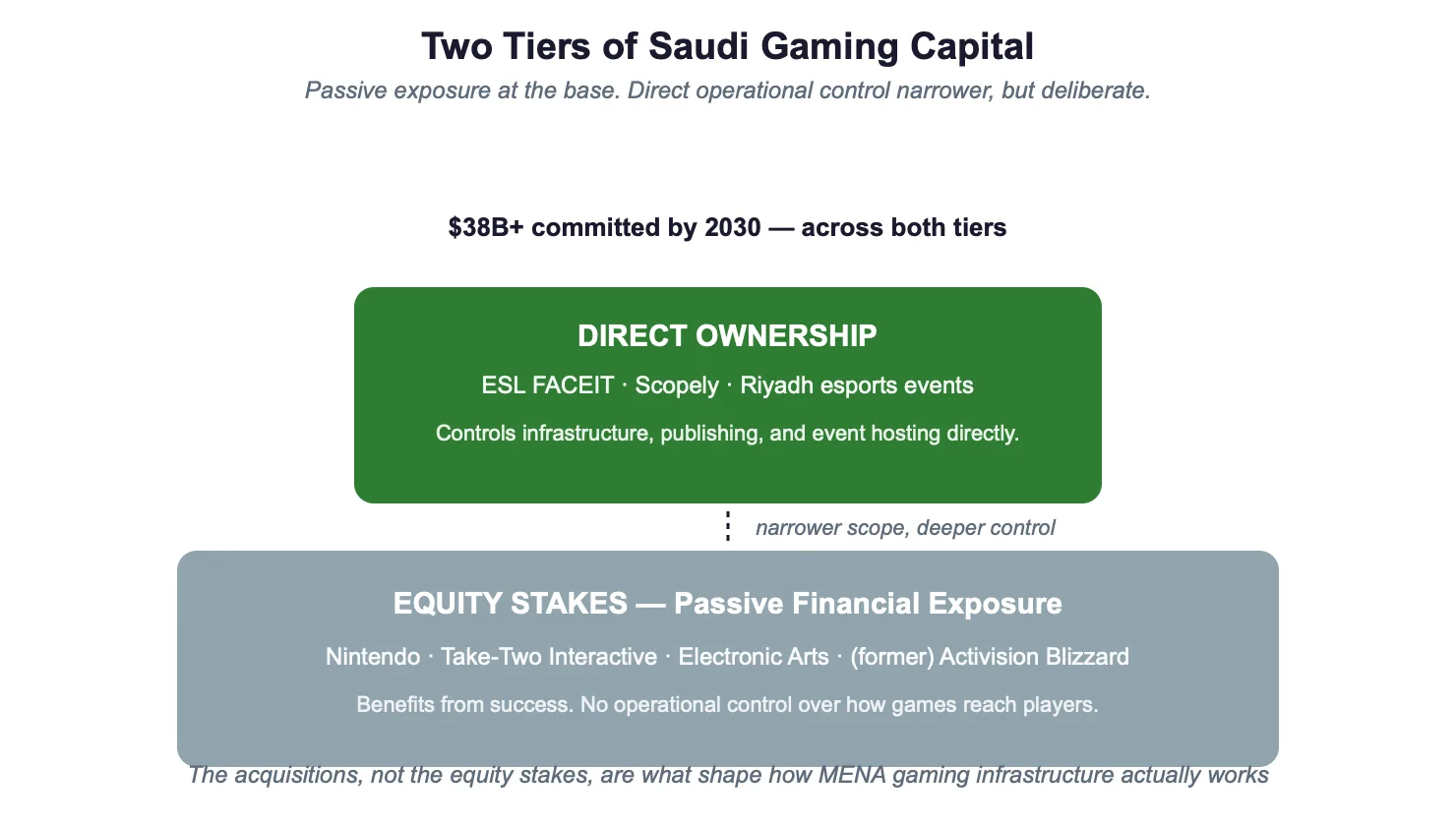
Start with the scale, because the number alone reframes the conversation. Savvy Games Group, wholly owned by Saudi Arabia's Public Investment Fund, has publicly committed to investing more than $38 billion into gaming by 2030, with an explicit stated goal of making the kingdom a genuine global hub for the industry, not merely an investor in it. That figure sits well beyond what a normal portfolio diversification play would require, and the spending pattern underneath it confirms the ambition is operational, not passive.
The clearest evidence is in what Savvy actually bought, rather than what it merely holds shares in. PIF's broader holdings include significant equity positions in major Western publishers — Nintendo, Take-Two Interactive, Electronic Arts, and at one point Activision Blizzard before Microsoft's acquisition closed — and that part of the portfolio does look like a fairly conventional sovereign wealth fund strategy, buying into proven, profitable companies without seeking operational control. But Savvy's direct acquisitions tell a different story entirely. The company bought ESL Gaming and FACEIT, two of the most significant esports infrastructure businesses in the world, merging them into a single entity that now controls a substantial share of competitive gaming's tournament and broadcast infrastructure globally. It bought Scopely, the mobile game publisher behind titles like Monopoly GO!, for a reported figure near $4.9 billion in 2023 — a deal specifically targeting mobile and casual publishing capability, not console or PC gaming, which signals an interest in exactly the segment of the industry with the broadest global reach and the lowest barrier to entry in emerging markets.

That distinction matters more than it might first appear. Owning equity in Nintendo gives Saudi Arabia financial exposure to console gaming's success. Owning Scopely outright gives Saudi Arabia direct operational control over a mobile publishing pipeline capable of reaching markets — including its own region — that console gaming was never going to penetrate as deeply in the first place. Owning ESL FACEIT gives it direct control over how competitive gaming events get organized and broadcast globally, rather than just sponsoring events that already exist. Each acquisition adds a layer of the value chain the kingdom now controls directly, rather than simply benefiting from at arm's length.
The events side of this reinforces the same pattern. Rather than primarily sponsoring established Western esports tournaments, Saudi Arabia has built its own marquee event infrastructure, including large-scale esports competitions hosted in Riyadh with substantial prize pools — choosing to become the venue and the organizer rather than remaining a sponsor attached to someone else's event calendar. That's a meaningfully different strategic posture than writing sponsorship checks, and it's consistent with the broader Vision 2030 economic diversification framework the kingdom has been building across entertainment and tourism more broadly, not gaming alone.
What this should signal to anyone evaluating MENA as a gaming market is fairly direct: this is not money sitting passively in a portfolio waiting for Western studios to perform well. It's capital actively building regional infrastructure, regional publishing capability, and regional event hosting capacity, with mobile and esports specifically identified as the layers worth owning outright rather than merely holding shares in. A company building distribution strategy for the MENA region without accounting for this — treating it as background noise rather than an active shaper of how the region's gaming infrastructure will actually function over the next several years — is missing one of the more consequential developments in the market it's trying to enter. Saudi Arabia isn't just betting that gaming will be valuable. It's building the specific pieces of infrastructure that determine how value gets captured in the region going forward, and that's a meaningfully different thing to be doing with $38 billion than simply buying stock.
🎮 Ready to play? Try these games on VPlay:
- Archer: Trial by Fate — Fantasy archery adventure with rich visuals that perform beautifully on mobile browsers
- Tank Force Hero — Tank combat action optimized for all device tiers and connection speeds
- Sky War — Aerial combat arcade game delivering console-style excitement in a browser tab
- Gym Boss — Lighthearted fitness-themed action perfect for quick mobile sessions
Play these games


More from the blog
The Developer's Guide to Getting Your Game Featured on a Portal
Every week, our team at VPlay reviews dozens of game submissions from developers around the world. Some are polished, some are rough, some are genuinely surprising. And every single developer who subm

What Actually Happens When a Web Game Goes Viral (And Why Most Portals Aren't Ready For It)
Going viral is supposed to be the good outcome. For an ad-monetized HTML5 portal, the first 48 hours of a genuine viral spike often look much closer to an operational emergency than a celebration, and

Ukraine and Romania Are Quietly Becoming Mobile Gaming's Fastest-Growing Markets
Mobile gaming market reports over the past couple of years have repeatedly flagged a cluster of Eastern European and Central Asian markets posting download and engagement growth well above global aver